Top Open Source AI Agent Memory Tools
Bottom line: Mem0 is the strongest general starting point; Graphiti and Cognee address more complex knowledge requirements; Hindsight is worth evaluating for advanced recall; and Letta Code is the better conceptual fit when memory is part of the autonomous-agent runtime.
Important distinction: these licenses apply to the identified software repositories, not automatically to the LLMs, embedding models, datasets, cloud services or third-party databases used alongside them.
Overall decision guide
| Your requirement | First choice | Alternative |
|---|---|---|
| General AI assistant memory | Mem0 | Supermemory |
| Historical and temporal reasoning | Graphiti | Hindsight |
| Organizational knowledge | Cognee | Graphiti |
| Long-running autonomous agents | Letta Code | Mem0 |
| Advanced conversational recall | Hindsight | Mem0 |
| Existing LangGraph application | LangMem | Mem0 |
| TypeScript-first development | Supermemory | Mem0 |
| Structured enterprise application memory | Memori | Cognee |
| Local MCP memory server | MCP Memory Service | Supermemory |
Detailed tool reviews

Mem0
Best general-purpose memory layer
Mem0 extracts useful information from conversations, stores it as persistent memories and retrieves relevant information when an agent needs it. It supports different memory scopes and integrations.
- Website
- mem0.ai
- Repository
- github.com/mem0ai/mem0
- License
- Apache-2.0
- Language
- Python
- Deployment
- Self-hosted + Cloud
- Activity
- Active; substantial ongoing repository development
Pros
- Broad integration ecosystem.
- Supports multiple vector databases and LLM providers.
- Relatively straightforward integration into existing applications.
Cons
- Memory extraction quality depends on model and configuration.
- External database and embedding choices introduce operational complexity.
- Hosted-platform features should not be assumed to exist in the self-hosted edition.
✓ When to pick: You want a reusable memory layer without replacing your existing agent architecture.
✗ When to avoid: You need sophisticated temporal reasoning across complex relationships or a complete autonomous-agent runtime.

Graphiti
Best for temporal knowledge graphs
Graphiti builds temporal knowledge graphs that preserve relationships, source information and changes over time. Unlike simple vector memory, it can represent when a fact was true and when it was learned.
- Repository
- github.com/getzep/graphiti
- License
- Apache-2.0
- Language
- Python
- Deployment
- Self-hosted
- Activity
- Active; ongoing development and releases
Pros
- Temporal relationship modeling.
- Supports incremental knowledge updates.
- Combines graph, keyword and semantic retrieval capabilities.
Cons
- Requires graph database infrastructure.
- More complex ingestion and schema management than basic vector memory.
- LLM-dependent extraction can produce incorrect relationships.
✓ When to pick: Historical relationships, changing facts and temporal queries are central to the application.
✗ When to avoid: You only need lightweight user-preference storage or a simple chat history.
Cognee
Best for organizational and document memory
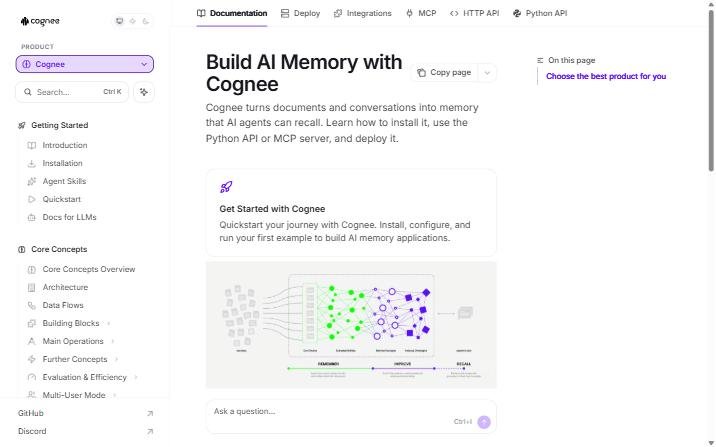
Cognee converts documents, conversations and other information into structured knowledge that agents can retrieve. Its extract-cognify-load approach combines knowledge graphs and vector retrieval.
- Website
- docs.cognee.ai
- Repository
- github.com/topoteretes/cognee
- License
- Apache-2.0
- Language
- Python
- Deployment
- Self-hosted
- Activity
- Active; frequent development
Pros
- Combines graph and vector retrieval.
- Supports local deployment.
- Offers MCP and multiple programming-language integrations.
Cons
- More complex than a simple memory SDK.
- Dependencies and configuration can increase deployment overhead.
- Graph extraction and indexing require additional processing.
✓ When to pick: You want to build a reusable knowledge base from multiple information sources.
✗ When to avoid: You only need a small persistent memory store for individual users.
Hindsight
Best for advanced memory retrieval
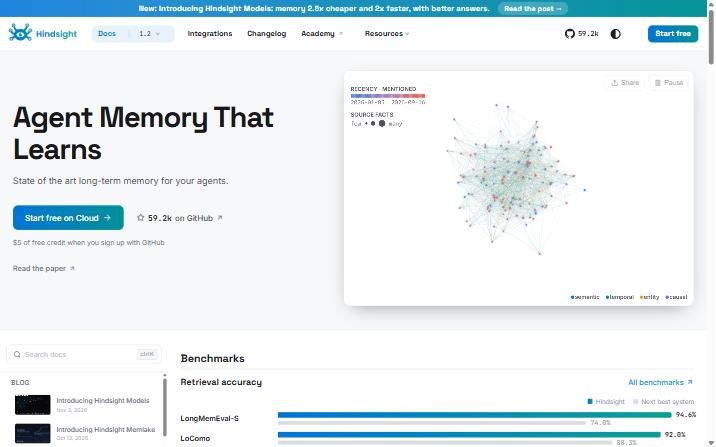
Hindsight is designed to let agents retain, retrieve and reason over information from previous interactions. Its retrieval architecture combines semantic search, keyword matching, graph traversal and temporal reasoning.
- Website
- hindsight.vectorize.io
- Repository
- github.com/vectorize-io/hindsight
- License
- MIT
- Language
- Python
- Deployment
- Self-hosted
- Activity
- Active; frequent releases and development
Pros
- Multiple complementary retrieval strategies.
- Includes retain, recall and reflect operations.
- Supports local and hosted LLM providers.
Cons
- More sophisticated than necessary for simple memory applications.
- Memory processing and retrieval require careful configuration.
- Production deployment introduces database and model-operation requirements.
✓ When to pick: You need more than basic similarity search and want several approaches to memory retrieval.
✗ When to avoid: Your application has minimal memory requirements or strict infrastructure simplicity requirements.

Letta Code
Best for stateful autonomous agents
Letta provides a stateful agent environment in which agents can maintain and modify their own memory, identity and working context. It follows the ideas introduced by MemGPT, including managing information across different memory layers.
- Website
- docs.letta.com
- Repository
- github.com/letta-ai/letta-code
- License
- Apache-2.0
- Language
- Node.js / Python
- Deployment
- Self-hosted
- Activity
- Active development in the current Letta Code repository
Pros
- Memory is integrated into the agent runtime.
- Agents can manage and update their own memory.
- Supports local and self-hosted operation.
Cons
- More opinionated than a standalone memory library.
- Requires learning its agent architecture.
- Less suitable when you only want a memory backend for an unrelated framework.
✓ When to pick: You want the agent itself to manage long-term context and learn from experience.
✗ When to avoid: You already have an established agent runtime and only need a memory API.

LangMem
Best for LangGraph developers
LangMem provides tools for extracting, updating and managing long-term memory in AI agents. It supports semantic, episodic and procedural memory patterns, with native LangGraph integration.
- Repository
- github.com/langchain-ai/langmem
- License
- MIT
- Language
- Python
- Deployment
- Self-hosted
- Activity
- Maintained, but release activity is quieter than the leading memory platforms
Pros
- Native LangGraph integration.
- Works with different storage systems.
- Provides both immediate and background memory-management approaches.
Cons
- Less compelling outside the LangGraph ecosystem.
- Requires LLM configuration for extraction operations.
- Release cadence is comparatively quiet.
✓ When to pick: Your application already uses LangGraph and you want memory-management primitives rather than a separate platform.
✗ When to avoid: You want a ready-to-deploy, independent memory server with minimal framework coupling.
Supermemory
Best for TypeScript and local-first memory
Supermemory provides a memory and context engine that can extract facts, maintain profiles and retrieve relevant information. It also offers local deployment and integrations with coding assistants.
- Website
- supermemory.ai
- Repository
- github.com/supermemoryai/supermemory
- License
- MIT
- Language
- Node.js / TypeScript
- Deployment
- Self-hosted
- Activity
- Active development
Pros
- TypeScript-oriented ecosystem.
- Supports local deployment.
- Combines memory, profiles and hybrid search.
Cons
- Its broader hosted platform should not be confused with the capabilities of the open-source repository.
- Local deployment still requires configuration and maintenance.
- Some ingestion and integration workflows may depend on external services.
✓ When to pick: You want a TypeScript-friendly memory engine with a local deployment option.
✗ When to avoid: You need a Python-native SDK or a highly specialized temporal knowledge graph.

Memori
Best for structured, application-level memory
Memori provides an agent-native memory layer that converts conversations and agent execution into structured persistent state. Its emphasis is on integrating memory with existing application infrastructure rather than requiring a complete platform replacement.
- Website
- memorilabs.ai
- Repository
- github.com/MemoriLabs/Memori
- License
- Apache-2.0
- Deployment
- Self-hosted
- Activity
- Active project, but comparatively quieter repository activity than the most frequently updated options
Pros
- LLM-agnostic design.
- Structured memory rather than only raw conversation storage.
- Supports different deployment arrangements.
Cons
- Less established ecosystem than Mem0.
- Additional configuration may be required for production.
- Some enterprise capabilities and integrations need separate evaluation.
✓ When to pick: You want structured agent memory that fits into an existing application and infrastructure environment.
✗ When to avoid: You want the largest available integration ecosystem or a very simple standalone memory component.

MCP Memory Service
Best for local MCP-based memory
MCP Memory Service provides persistent memory through the Model Context Protocol, REST API and HTTP transport. It is designed to make memory accessible to compatible AI assistants and agent frameworks without requiring a proprietary hosted memory provider.
- License
- Apache-2.0
- Language
- Python
- Deployment
- Self-hosted
- Activity
- Active development; the repository documents a September 2026 release
Pros
- MCP and REST interfaces.
- Local vector-search support.
- Supports memory consolidation and knowledge organization.
Cons
- Requires operating and maintaining a memory service.
- MCP compatibility does not guarantee identical integration quality across clients.
- Less suitable for applications requiring a highly specialized temporal graph model.
✓ When to pick: You want a self-hosted memory service that can connect to multiple MCP-compatible clients.
✗ When to avoid: You need a fully integrated autonomous-agent runtime or sophisticated temporal reasoning as the primary feature.